Wednesday, May 18, 2016

The Monkeys of Gibraltar

This week we're driving. Like my dad, I love public transportation especially riding on trains. But this gives one a different view and a bit of freedom. We'll have the car until we leave Granada next Monday. Last night we stayed in a wonderful B&B on the Mediterranean coast.

Yesterday we spent part of the day outside of Spain in the city of Gibraltar. To get to Gibraltar (which is a British territory), we parked in a little town in Spain and walked through customs. Gibraltar is a narrow peninsula and its airport is between customs and the town which means you have to walk or drive across the runway which runs the width of the peninsula. There is a sign at each end asking pedestrians to please remember that this is a working runway and don't litter because any piece of litter could cause an accident. Here is Doug on the runway with the Rock in the background.


The town itself is rather nondescript, hardly worth the time. We went for the fun of taking the cable car to the top of the rock and walking down. There is a type of ape that lives on the rock that is called the Barbery Maqaque. It is the only wild monkey population on the European continent. They are everywhere at the top of the rock and quite used to people. We were warned many times not to carry plastic grocery bags and to watch our backpacks as the apes are known to grab them hoping for food. We had no problem with them, but then we weren't carrying anything.


Because of its strategic location where the Mediterranean flows into the Atlantic Ocean and being just a few miles from the coast of Morocco (we could easily see it from the rock), it has had an interesting history. It is a mix of Spaniards, Brits, Moroccans, and us ubiquitous tourists.

In this photo we're looking down on the town and north into Spain. The runway is visible on the left near the center of the photo.


Tuesday, May 17, 2016

The Grandeur of Age

There is something about the age of things that is incredibly moving. I used to feel such awe when I worked in the archives and handled handwritten letters that were a hundred years old or even, for that matter, fifty years old. The thought that another human being, a living and breathing person, was at the other end of the pencil that wrote this note always moved me. I felt connected to that person when I handled that paper. So here in Spain there have been many things even older than those letters that we have been seeing and touching. It is difficult to describe the feeling when I connect to other eras and other peoples in this way.

A few of the many old things we saw today were a candle from 1767, a carving of a palm tree from the third century, a fourteenth century wall painting in a church, and mosaics from a Roman town that was founded in 206 B.C. It was humbling to stand near, even to touch these objects and consider the life of those who created or handled these things in earlier times.


A restored 14th century wall painting in the Church of Santa Maria in Arcos de la Frontera.


A Roman era Palm Tree of Life carving that was from a third century Roman altar. It was then incorporated into a Moorish mosque. After the Christians reclaimed this part of Spain in the thirteenth century, they tore down the mosque, but kept this palm tree in the foundation of the Church of Santa Maria in Arcos de la Frontera. 


A bird mosaic from the Roman town of Italica. Italica was founded in 206 B.C. I'm not sure when this mosaic was laid. There are more than thirty species of birds depicted in this mosaic.


A rather funky Easter candle from 1767, still residing in the Church of Santa Maria in Arcos de la Frontera. It is about six feet tall.

Monday, May 16, 2016

Sevilla

We're staying in Sevilla in a beautiful little hotel in the old Jewish quarters. All indication of the Jews were erased from this ghetto just like the Jews were eraticated (either exiled or killed) during the horrors of the Spanish Inquisition. It is a maze of very narrow alleyways where no cars can drive. The reason it has such narrow alleys is that the Jews were confined to a specific, very small space and couldn't build up more than a story or two. So they had to make use of all space as much as possible. Below is the small plaza just outside the door of our hotel.


We saw the Sevilla Cathedral and the Alcazar (pronounced Al-CATH-ar) which is the palace. The Alcazar was impressive in its utilization of both Moorish (Muslim) architecture and Christian/western architecture; this style is called "mudejar". The palace was built by Muslim craftsmen and builders, but built for a Catholic king, Peter. The palace and the gardens were beautiful, but I was completely smitten by the underground pool that they built on the grounds -- a welcome relief on a hot day like today. This idea was genius, especially in a hot climate with no air conditioning.

a door with the beautiful tile that is everywhere in the city, as well as everywhere in the Alcazar


Can't you almost feel the coolness of this subterranean pool?


Arches and entry into one section of the palace

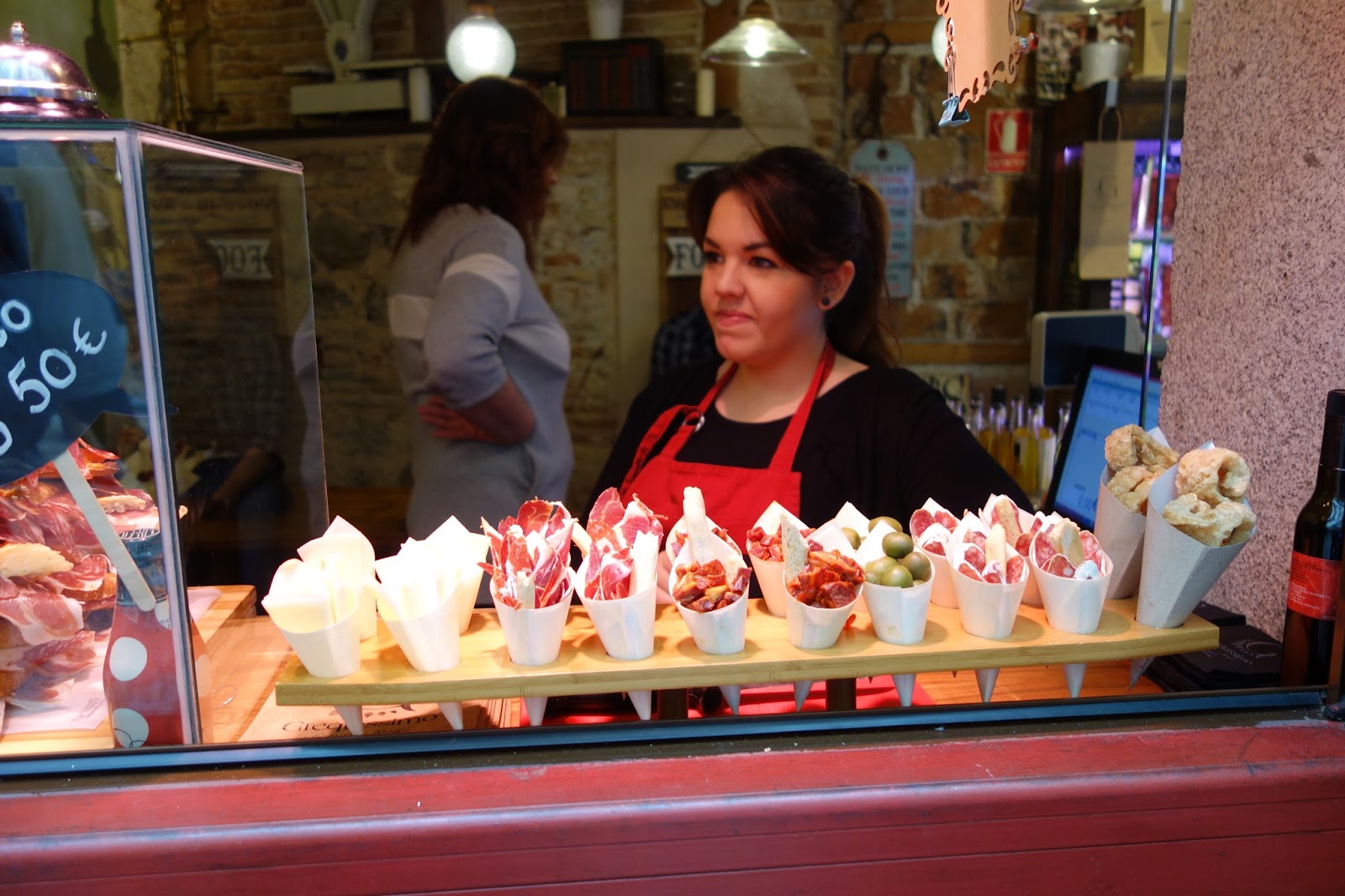
Finally, the specialty of all of Spain is jamon (ha-MONE/ham.) Each area has its own way of making it. On the street you can buy it in little white paper cones for a snack, which I tried several times, of course.


And now for a shot of Doug outside the castle, keeping the sun from beating down on his pate.


Sunday, May 15, 2016

Toledo

We took a day trip by train to Toledo. By bullet train, it is only a half hour trip and well worth it. Toledo has one of the most impressive cathedrals I've seen. It was built between 1226 and 1463. The site where it stands was first a Visigothic cathedral, then a mosque, and then this cathedral. It is a hodge-podge of styles that has many impressive features, but one stands out. About 60 feet up, a sculptor cut a hole in the ceiling that would shed light on a wall  of his alabaster sculptures of biblical scenes at the back of the altar. The detail in the wall is amazing, but even more so are the carvings around the hole in the ceiling.

This is only one of the things that made a trip to Toledo worth at least a day.


Toledo is also known for the place where El Greco painted in the sixteenth and seventeenth centuries. His paintings were all over -- in the cathedral, in San Tomas, in several museums.

Then there is the mazapan that Toledo makes. It is in every shop and made in every shape. It was especially fun to buy some from one of the convents. The nuns are particularly good at making different versions of this confectionery, which is quite tasty. It is made mostly with almonds and honey. We had more than one piece.


The streets of Toledo were a maze, fun to find our way around. Even a map was of little help at times. It was an interesting challenge to not get lost -- and we didn't. I would never have considered driving in this city and you can see why in these photos.


Last full day in Madrid with Rachel

On our last full day in Madrid with Rachel, she took us on a nice long walk through Retiro Park. Then we went to La Mallorquina, a confiteria with great pastries, after which she took the Metro back to her host mother's home for a late dinner. The pastries were exquisite -- Rosaquillas and Napolitanas for all -- and as full as the place always is, it's obvious we aren't the only ones to think the place is great.

Tomorrow we take a day train to Toledo and Rachel goes to meet her parents in Rome.


This is at the turtle pond by the conservatory in Retiro Park.


Last night in Plaza Del Sol eating Napolitanas together.

Friday, May 13, 2016

Prado and a Walking Tour

We spent the first full day in Madrid at the Prado, the art museum. One can only see so many "Mary and child" paintings, but I lasted the full day. I even found a few lesser known Spanish romantic artists that I liked and had never heard of before. They tended to paint every day life instead of grand biblical scenes. I went in fully expecting to leave after a few hours and let Doug look to his heart's content, but I stayed.

In the late afternoon and evening we did a walking tour of the center of Madrid and had a bite to eat in a little hole in the wall where they were watching Nadal play tennis. I tried a local special -- bocadillo de calamares (fried squid sandwich.) Once was enough but I'm glad I tried it once. We got dessert at La Mallorquina, a confiteria with very tasty pastries. It was a good day and I walked almost 20,000 steps -- over eight miles. I feel great!

Spain and the Spanish people are on a very different schedule than I am used to. They eat dinner about 9 pm and seem to stay out all night (or much of it.) Even children are out late. Rachel can vouch for this difference -- she must have had quite an adjustment this semester. We hear people on the street outside our apartment until almost 4 a.m.


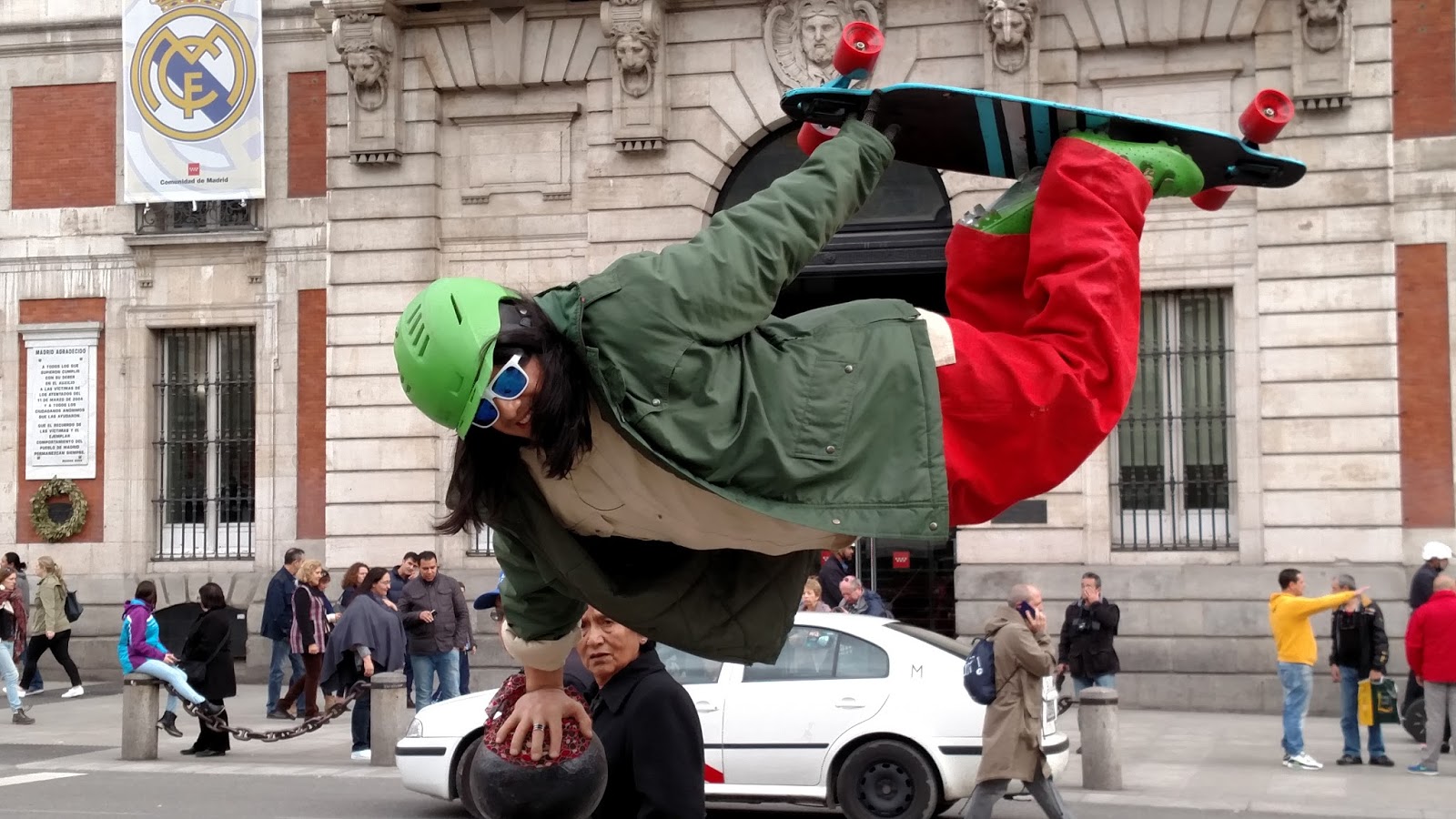
Here are a few shots of street artists we saw on our walking tour.
We couldn't figure out the trick of the first person who is resting on one arm with feet in the air. The chess player is a real guy, but he certainly looked like a statue.


We also saw a political demonstration in the Plaza Del Sol. They were calling for reparations to families who lost members during the Franco regime. Franco's reign ended with his death in 1975.


Wednesday, May 11, 2016

First Day in Madrid

Time to go to bed. We've been up way too long, but we arrived safely in Madrid this morning and found our way downtown. We located our apartment, got our keys, and then Rachel met us for lunch and a walk around this part of Madrid.


Rachel is a wonderful and knowledgeable hostess and tour guide. Her sociology classes and her own curiosity have served her well and she can tell us much about Madrid, Spain, and the Spanish people. After lunch and a walk around the area, we shared chocolate and churros. 


That's all for now. Happy to be here. And good night, Mom. It's time to sleep so we can get up and go to the Prado tomorrow morning. The rain held off until now, so I get to go to sleep with the pleasant sound of rain falling on our balcony that overlooks the narrow little street outside our apartment. And even if it's raining in the morning, we'll be in the Prado which Doug declares to be the best art museum in Europe.